
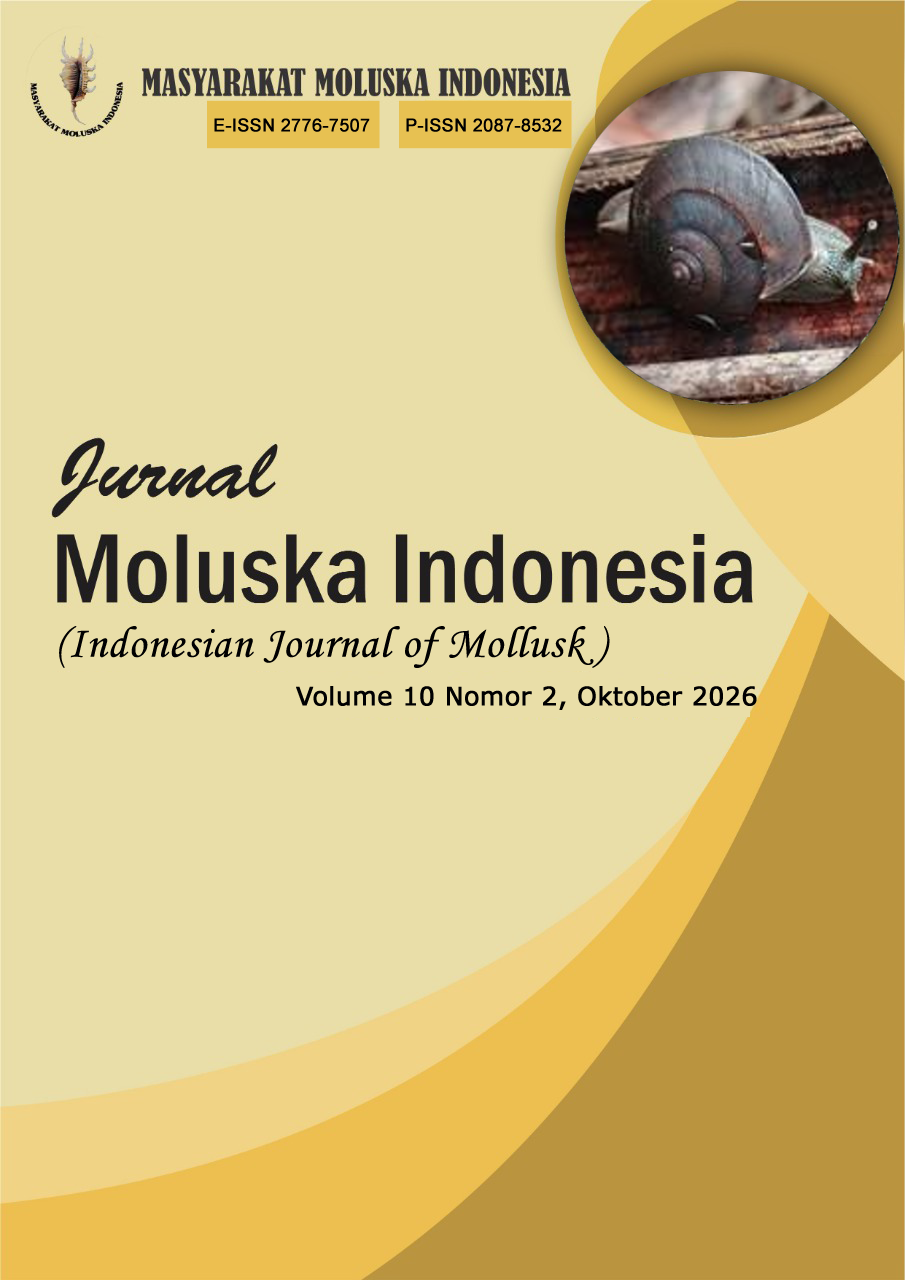
Inventory and Morphological Description of Land Snails in the Gunung Selatan Protection Forest, Tarakan Island
Article Sidebar
Land Snails,
Morphology ,
South Mountain,
Tarakan
Main Article Content
Abstract
Gastropods are generally found in aquatic areas, but some gastropods live in terrestrial environments, such as land snails. Forests are ideal habitats for land snails, such as the protected forest area of the southern mountain in Tarakan City. However, preliminary data on land snail species in this area is still limited. This study aims to identify and describe land snail species in the protected forest of the southern mountain in Tarakan City. This study used a purposive sampling method at four research stations, establishing 20 x 20 m plots at each station. Sampling was carried out by four researchers from morning to afternoon at each station, exploring the research plot area and measuring abiotic parameters such as temperature, light intensity, air humidity, soil moisture, and soil pH. The results revealed five land snail species: Macrochlamys tersa, Dyakia rumphii, Japonia borneensis, Quantula striata, and Kaliella doliolum. Furthermore, the measurement results for the parameters indicate conditions favorable for the survival of land snails.
Downloads
Article Details

This work is licensed under a Creative Commons Attribution-NonCommercial-NoDerivatives 4.0 International License.
References
Baharuddin, N., & Satyanarayana, B. (2024). Diversity and abundance of mangrove gastropods in setiu wetlands and matang mangrove forest reserve, Peninsular Malaysia. Ilmu Kelautan: Indonesian Journal of Marine Sciences, 29(4): 425–432. https://doi.org/10.14710/ik.ijms.29.4.425-432.
Barzaghi, B., Manenti, R., Ficetola, G. F., Pennati, R., & Melotto, A. (2025). Light in the darkness: Responses to light and diel activity rhythm in an eyeless cave flatworm (Dendrocoelum italicum). Ecology and Evolution, 15(6), e71584. https://doi.org/10.1002/ECE3.71584
Benson, W. H. (1836). Descriptive catalogue of terrestrial and fluviatile Testacea, chiefly from the North-East frontier of Bengal. The Journal of the Asiatic Society of Bengal. 5 (54): 350-358.
Foon, J. K., Effendi, M., & Marzuki, B. (2023). A checklist of land snails (Mollusca, Gastropoda) of Batu Caves, Selangor, Malaysia. Malayan Nature Journal, 75(1), 133–148. http://malaypeninsularsnail.myspecies.info.
Gheoca, V., Benedek, A. M., & Schneider, E. (2021b). Exploring land snails’ response to habitat characteristics and their potential as bioindicators of riparian forest quality. Ecological Indicators, 132, 108289. https://doi.org/10.1016/J.ECOLIND.2021.108289.
Grimm, F. W., Forsyth, R. G., Schueler, F. W., & Karstad, A. (2009). Identifying land snails and slugs in canada: Introduced species and native genera. Cette publication est aussi. https://www.researchgate.net/publication/289377614
Gray, J. E. (1834). Several shells, which … referred to a genus to be separated from Helix under the name of Nanina. Proceedings of the Zoological Society of London. (1834) 2: 58-59.
Heryanto. (2017). Keanekaragaman keong di Pulau Enggano, Bengkulu Utara. Berita Biologi, 16(1), 101–110.
Irsyad, F. L. H., Sari, F. J. P., Nurlela, E., Cahyanto, T., & Nurinsiyah, A. S. (2015). Keanekaragaman genus keong darat di kawasan kars Pegunungan Sewu Kabupaten Gunungkidul, Yogyakarta. Dalam Prosiding Seminar Nasional Biologi, Lingkungan, dan Pembelajaran. Pendidikan Biologi FITK UIN Syarif Hidayatullah Jakarta.
Lee, J. Y., Nasir, N. S., Marzuki, M. E., Vermeulen, J. J., & Khalik, M. Z. (2024). The land snail fauna of Batu Kudik, isolated limestone outcrop near Simunjan, Sarawak, Malaysian Borneo (Mollusca, Gastropoda). Biodiversity Data Journal, 12. https://doi.org/10.3897/BDJ.12.e115556.
Magapan, C. A., & Ybañez, C. O. (2025). First survey of land snails in mount hamiguitan: Biodiversity and environmental insights from a UNESCO world heritage and ASEAN Heritage Park in the Philippines. Zoological Studies, 64, e36. https://doi.org/10.6620/ZS.2025.64-36.
Marwoto, R. M., Heryanto, Isnaningsih, N. R., Mujiono, N., Alfiah, & Prihandini, R. (2020). Moluska Jawa (1st ed.). Penerbit IPB Press.
Marzuki, M. E. Bin, Liew, T. S., & Mohd-Azlan, J. (2021). Land snails and slugs of bau limestone hills, sarawak (Malaysia, borneo), with the descriptions of 13 new species. ZooKeys, 1035, 1–113. https://doi.org/10.3897/zookeys.1035.60843.
Mawardi, A. L., Khalil, M., Sarjani, T. M., & Armanda, F. (2023). Diversity and habitat characteristics of gastropods and bivalves associated with mangroves on the east coast of Aceh Province, Indonesia. Biodiversitas, 24(9), 5146–5154. https://doi.org/10.13057/biodiv/d240959.
Nandy, G., & Aditya, G. (2022). Temperature dependent variations of life history traits of the land snail Allopeas gracile (Hutton, 1834) (Gastropoda: Subulinidae). Journal of Thermal Biology, 108, 103297. https://doi.org/10.1016/J.JTHERBIO.2022.103297.
Nugroho, B. A., & Putri, E. A. W. (2024). Molluscan diversity the mangrove ecosystem of Tarakan Island Indonesia. BIOMA: Jurnal Ilmiah Biologi, 13(1), 50–68. https://doi.org/10.26877/bioma.v13i1.661.
Nunes, G., & Santos. (2012). Environmental factors affecting the distribution of land snails in the Atlantic Rain Forest of Ilha Grande, Angra dos Reis, RJ, Brazil. Braz. J. Biol, 72(1), 79–86.
Nurhayati, P. A., Herdiawan, B., & Dwitara, G. A. C. (2020). Inventory of land snail in Darungan Lake, Bromo Tengger Semeru National Park. Jurnal Biota, 6(1), 42–44. http://jurnal.radenfatah.ac.id/index.php/biota.
Nurinsiyah, A. S., Faizah, I., Prasetio, Y., Setiadi, T., Marwoto, R. M., & Hausdorf, B. (2020). Diversity and ecology of land snails in gunung Halimun Salak National Park (GHSNP) in Java, Indonesia. Zoo Indonesia, 28(1), 46–58. https://doi.org/10.52508/zi.v28i1.3956.
Ogasawara, T., & Tasaki, K. (1982). A circadian locomotor rhythm in the giant land snail, Achatina fulica. The Tohoku Journal of Experimental Medicine, 137(1), 109–110. https://doi.org/10.1620/TJEM.137.109.
Otunla, T. A., Osanaiye, O. J., & Olosunde, F. O. (2024). Effect of relative humidity and temperature on reproductive performance of African giant land snails (Archachatina marginata) reared under intensive management during dry season. 49th Annual Conference of Nigerian Society for Animal Production, 1954–1957.
Palungana, C. J., Umar, H. S., Nirmala, A. S., & Nugroho, B. A. (2024). Diversity and dominance of earthworms in relation to abiotic factors in the Gunung Selatan Forest of Tarakan Island. Biological Environment and Pollution, 4(2), 79–86. https://doi.org/10.31763/BIOENVIPO.V4I2.826.
Perea, J., Garcia, A., Gómez, G., Acero, R., Peña, F., & Gómez, S. (2007). Effect of light and substratum structural complexity on microhabitat selection by the snail Helix aspersa. Journal of Molluscan Studies, 73(1), 39–43. https://doi.org/10.1093/mollus/eyl031.
Ponder, W. F., Lindberg, D. R., & Ponder, J. M. (2019). Biology and evolution of the mollusca. In biology and evolution of the mollusca (1st ed., Vol. 1). CRC Press. https://doi.org/10.1201/9781351115667.
Prayudi, S. D., Korin, A., & Kaminski, M. A. (2024). Thermal tolerance of intertidal gastropods in the Western Arabian Gulf. Journal of Sea Research, 197, 102470. https://doi.org/10.1016/J.SEARES.2024.102470
Pfeiffer, L. (1842). Symbolae ad historiam heliceorum (Vol. 2). Th. Fischer.
Pfeiffer, L. (1846). Descriptions of nine new species of Helicea, collected by Hugh Cuming, Esq. Proceedings of the zoological Society of London. 14 (158-160): 41–43.
Schweizer, M., Triebskorn, R., & Köhler, H. R. (2019). Snails in the sun: Strategies of terrestrial gastropods to cope with hot and dry conditions. Ecology and Evolution, 9(22), 12940–12960. https://doi.org/10.1002/ece3.5607
Smith, E. A. (1893). Descriptions of new species of land-shells from Borneo. Journal of the Linnean Society, Zoology. 24(154): 341–352.
Sutcharit, C., Tongkerd, P., Tan, S.-H. A., & Panha, S. (2012). Taxonomic revision of dyakia janus from peninsular Malaysia (pulmonata: dyakiidae), with notes on other sinistrally coiled helicarionoids. The Raffles Bulletin of Zoology, 60(2), 279–287.
Uchida, R., Yahya, B. E., Ahmad, A. H., Sapaat, A., & Tomiyamal, K. (2013). Land snail fauna of Sabah, Borneo, Malaysia. Venus, 71(1). https://doi.org/10.18941/venus.71.1-2_49.
Vermeulen, J. J., Liew, T. S., & Schilthuizen, M. (2015). Additions to the knowledge of the land snails of Sabah (Malaysia, Borneo), including 48 new species. ZooKeys, 531(531): 1–139. https://doi.org/10.3897/ZOOKEYS.531.6097.
Wijaya, W. A., Sukandar, P., & Meitiyani. (2019). Keanekaragaman jenis keong darat di Taman Wisata Alam Telaga Warna, Bogor, Jawa Barat. Bioeduscience, 03(01).
Zimmermann, S., Gärtner, U., Ferreira, G. S., Köhler, H. R., & Wharam, D. (2024). Thermal impact and the relevance of body size and activity on the oxygen consumption of a terrestrial snail, Theba pisana (Helicidae) at high ambient temperatures. Animals, 14(2):261. https://doi.org/10.3390/ANI14020261/S1.